Mark Your Calendar for the April 28 Spring Economic Statement

Mark your calendar for the April 28 Spring Economic Statement and KBR’s Special Report. One cannot help but wonder what taxing provisions may be buried in its pages, coming just two days before the tax filing deadline. This important statement is a touch base on Canada’s finances, bridging two federal budgets and this deserves the full attention of taxpayers and their advisors. Here’s why:
The Backdrop. In the past, when spring budgets were the norm, it was the Fall Economic Statement that brought a report card on the government’s fiscal position.
Now starting with the November 4, 2025 Federal Budget, the budget cycle is reversed, and this first Spring Economic Report provides that news: updated projections for the deficit, interest on  the debt, unemployment rates, debt-to-GDP ratios, and targeted tax measures to set the government’s plans for growth and spending.
Since the upcoming fiscal update is the first since the budget was tabled in the fall, and much has changed in the global economy, forecasting to bring comfort to Canadian investors may be a unique challenge. This is particularly troubling because impartial analysis on the fiscal reporting in the SES is missing an important commentator.
The House of commons has now approved the appointment of Annette Ryan as the new Parliamentary Budget Officer. The vote was relatively close with Ryan receiving 164 votes in her favour and 153 opposed.
She replaces Jason Jacques who had been serving on an interim basis although the position has been vacant most recently.
To be clear, the OECD describes the critical responsibilities of the PBO, which include “regular non-partisan, independent analysis to Parliament on the federal budget, the government’s estimates. . .and at the request of parliamentarians, research on national finances, government estimates, or the financial cost of any proposals within Parliament’s jurisdiction.”
The government has nominated Anette Ryan for the post, but she has not yet been confirmed by Parliament. This is not good. The PBO has a critical role in keeping both Parliament and the Canadian people informed about the government’s fiscal strategy, including this Spring Economic Update.
Analysis of Quality of Fiscal Reporting. There were scathing words from the last PBO after the November 4 Budget, noting that the federal government has limited room to cut taxes or increase spending if it wants to keep the federal debt-to-GDP ratio in 2055–56 at or below its current level. Here’s what was said by the Interim PBO, Jason Jacques:
“Budget 2025 projects the debt-to-GDP ratio will stay mostly stable over the next 30 years,” “This is different from the last three years, when fiscal policy provided more flexibility to deal with future risks” . . .and “Our analysis shows there is only a 7.5% chance the deficit-to-GDP ratio will fall every year from 2026–27 to 2029–30. This means the Government’s new anchor is unlikely to hold.”
While four G7 countries have higher net debt to GDP ratios, Canada’s is still roughly 110%, leaving little wiggle room for the government in terms of borrowing and spending.
The PBO was also critical of the Government’s definition of “capital investment”. He believed it is too broad. Based on international practice, it said, capital investments would total $217 billion from 2024–25 to 2029–30—about $94 billion less than Budget 2025 estimates. The recommendation: “To improve transparency, an independent expert group should decide what counts as capital investment under the expanded definition.”
Perhaps the PBO is concerned that this new system allows for a new way for the finance department to explain away – or gloss over - significant deficit spending that is rather more operational in nature.
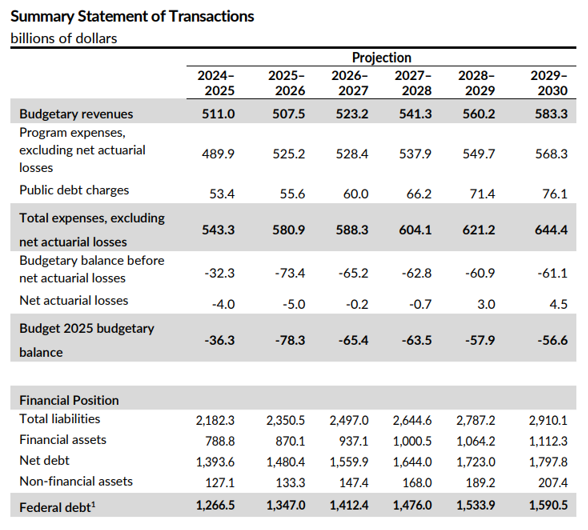
Fiscal Position Update: The update will provide updated figures on the deficit, which was forecasted in November 2025 ( see below) to be over $65 billion for the 2026-2027 fiscal year. The number may be higher following temporary cancellation of the fuel excise tax, which is expected to cost the government $2.4 billion.
Response to Global Shocks: The statement will likely address how recent "global shocks" or international instability affect Canada's economic forecasts. The conflicts in Iran and Lebanon have contributed to an already shifting global economy.
The government aims to show it is building the strongest economy in the G7, with a focus on "building Canadian" through major infrastructure projects and increased defense spending. There may be some information in the update regarding how the government intends to roll out this strategy.
Economic Strategy: The plan is expected to include initiatives on skills training, regional workforce strategies, and supporting business competitiveness to foster long-term prosperity.
Tax Strategy: While he has been able to operate with a de facto majority, Prime Minister Carney now has an official majority in the Commons and a co-operative Senate. He won’t have to face the electorate for two more years so he may be tempted to implement some new tax measures. He has ample political capital and by imposing some new taxes, particularly on high income earners, he can afford to spend some of that capital.
But the risk is brain drain – our brightest and most innovative people are also mobile and may seek a more tax friendly jurisdiction in that case. That would be a blow to our long term economic growth.
The Tariff Impact: There is still no new trade deal with the United States and there remains a high degree of uncertainty. Carney has assembled a veteran committee to work out a strategy for dealing with an American administration which continues to display hostility toward Canada as a trading partner. The government has been focussed on developing new trade deals with other nations but it may take some time for those deals to bear fruit. Expect the fiscal update to include information on potential new markets for Canadian goods.
Cost-of-Living Measures: Previously announced measures have included a boost to the GST benefit and the implementation of a plan to waive the federal fuel excise tax until September 7 will likely be highlighted. But will there be much needed tax relief to put more money in the pockets of workers at payday to pay rent, buy food and stimulate the economy?
The Bottom Line: When Finance Minister Francois Philippe Champagne rises to deliver the fiscal update on the 28th, he will be a difficult position of having to be careful about spending and deficits while at the same time needing to provide relief for Canadians who have seen their living standard decline steadily over the past ten years.
 Help & Contact: 1 866 953 4769